And still, Namibia is a country for the whole year. For green landscapes, dramatic thunderstorm skies, migratory birds, and young animals, the rainy season from November to April is a surprisingly beautiful alternative, often at much better prices. Which time of year is right for you depends on what you want to experience, who you travel with, and which region you're heading for.
In this guide we show you, month by month, what the weather in Namibia is like, when safari, hiking, the coast, or hunting are most worthwhile, and what to keep in mind when you travel with children. We know the country firsthand, because Okavandu lies in the middle of the Erongo Region and many tours begin and end with us.
Best time to visit Namibia at a glance
The overview below shows how the dry season and the rainy season differ. The temperatures refer to Windhoek and carry over well to the central highlands.
| Criterion | Dry season (May to October) | Rainy season (November to April) |
|---|---|---|
| Season | Namibian winter | Namibian summer |
| Daytime temperature in the highlands | about 20 to 29 °C | about 26 to 31 °C |
| Nighttime temperature in the highlands | about 6 to 15 °C, frost possible | about 13 to 17 °C |
| Rainfall in Windhoek | hardly any rain, about 1 mm a month from June to August | mostly 27 to 79 mm a month, short and heavy showers |
| Landscape | golden brown, clear views, little haze | green, dramatic clouds, thunderstorm mood |
| Wildlife viewing | very good, animals gather at waterholes | more demanding, animals spread out, many young animals |
| Prices and crowds | peak season, higher prices, more guests | low season, often cheaper, quieter |
For most travelers, the ideal period is between May and September. Days are warm but not hot, nights are clear and cool, rain is the exception, and wildlife viewing works best. If fresh green matters most, plan on May; for the most animals at the waterholes, pick September and October.
Rainy season and dry season in Namibia: what does that mean exactly?
Namibia lies in the Southern Hemisphere, so its seasons are the reverse of Germany's. Winter, and with it the dry season, lasts from about May to October; summer, and with it the rainy season, from November to April.
When does the rainy season start in Namibia?
The first thunderstorms usually come in October and November, the so-called small rainy season. Most of the rain falls from January to March, which in Windhoek comes to about 77 to 79 millimeters a month on the long-term average. From April on, the rain eases off noticeably, and by May it's usually dry.
Does it rain all day in the rainy season?
No. Rain in Namibia usually comes in short, heavy bursts, often as a thunderstorm in the afternoon, and it rarely falls everywhere at the same time. It can pour in one place while it stays dry a few kilometers away. Between the showers the sun shines, and over the whole year Namibia gets about 300 days of sunshine.
What does the rainy season mean if you drive yourself?
After heavy rain, dry riverbeds can carry water for a short time, and some gravel roads then become impassable. Before longer stretches, ask your lodge about the current state of the road and plan in buffer time.
Namibia's climate month by month
The highlands around Windhoek show the seasons especially clearly. The table below gives the temperatures and rainfall month by month.
| Month | Day °C | Night °C | Rain mm | Rainy days | Sun h/day | Character |
|---|---|---|---|---|---|---|
| January | 30.0 | 17.2 | 78 | 8 | 8.7 | hot, rainy season, green |
| February | 28.6 | 16.5 | 77 | 9 | 8.0 | rainy season, thunderstorms |
| March | 27.2 | 15.4 | 79 | 8 | 8.1 | late rainy season, at its lushest |
| April | 25.6 | 12.8 | 38 | 4 | 9.4 | transition, fresh and green |
| May | 22.7 | 9.2 | 7 | 1 | 9.7 | dry, clear days |
| June | 20.2 | 6.7 | 1 | 0 | 9.9 | dry, cool, frost possible |
| July | 20.5 | 6.3 | 1 | 0 | 10.0 | dry, coldest nights |
| August | 23.4 | 8.6 | 1 | 0 | 10.3 | dry, sunniest month |
| September | 26.5 | 11.9 | 3 | 0 | 10.1 | warm, dry, lots of game |
| October | 29.1 | 14.6 | 11 | 2 | 10.0 | hot, first showers possible |
| November | 29.6 | 15.6 | 27 | 4 | 10.0 | heat, small rainy season |
| December | 30.7 | 16.9 | 42 | 5 | 10.2 | hottest month |
January to March: hot, green, and stormy
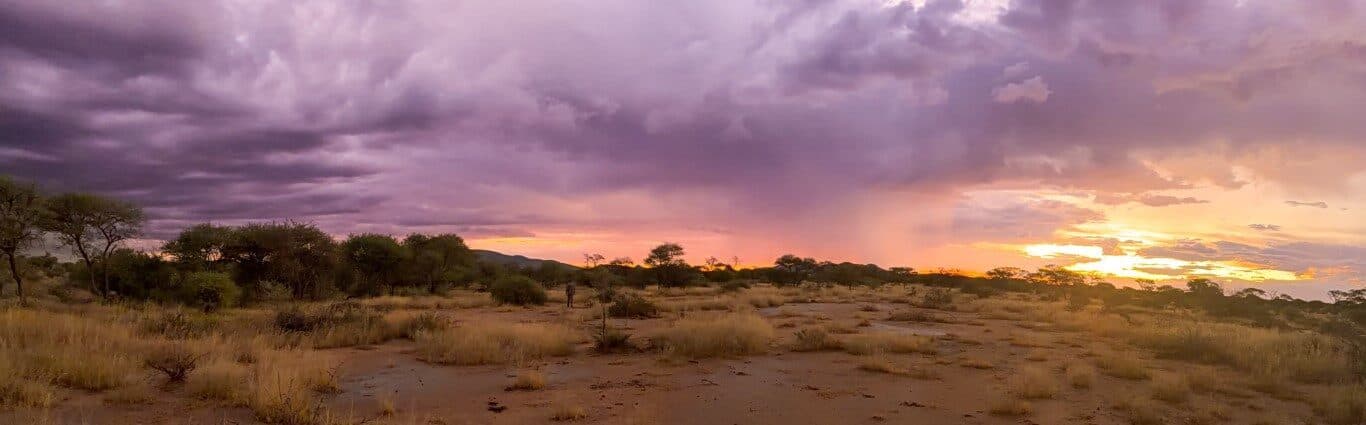
During the day it's 27 to 30 °C in the highlands, at night a pleasant 15 to 17 °C. The thunderstorms usually come in the afternoon, after which the sky clears quickly. The landscape is now at its greenest, with many young animals and migratory birds. In Etosha and in the desert it's much hotter, so this time suits long safari days or hikes less well. Prices are lower in return, except during the school vacations in January.
April and May: the transition with green land and clear air
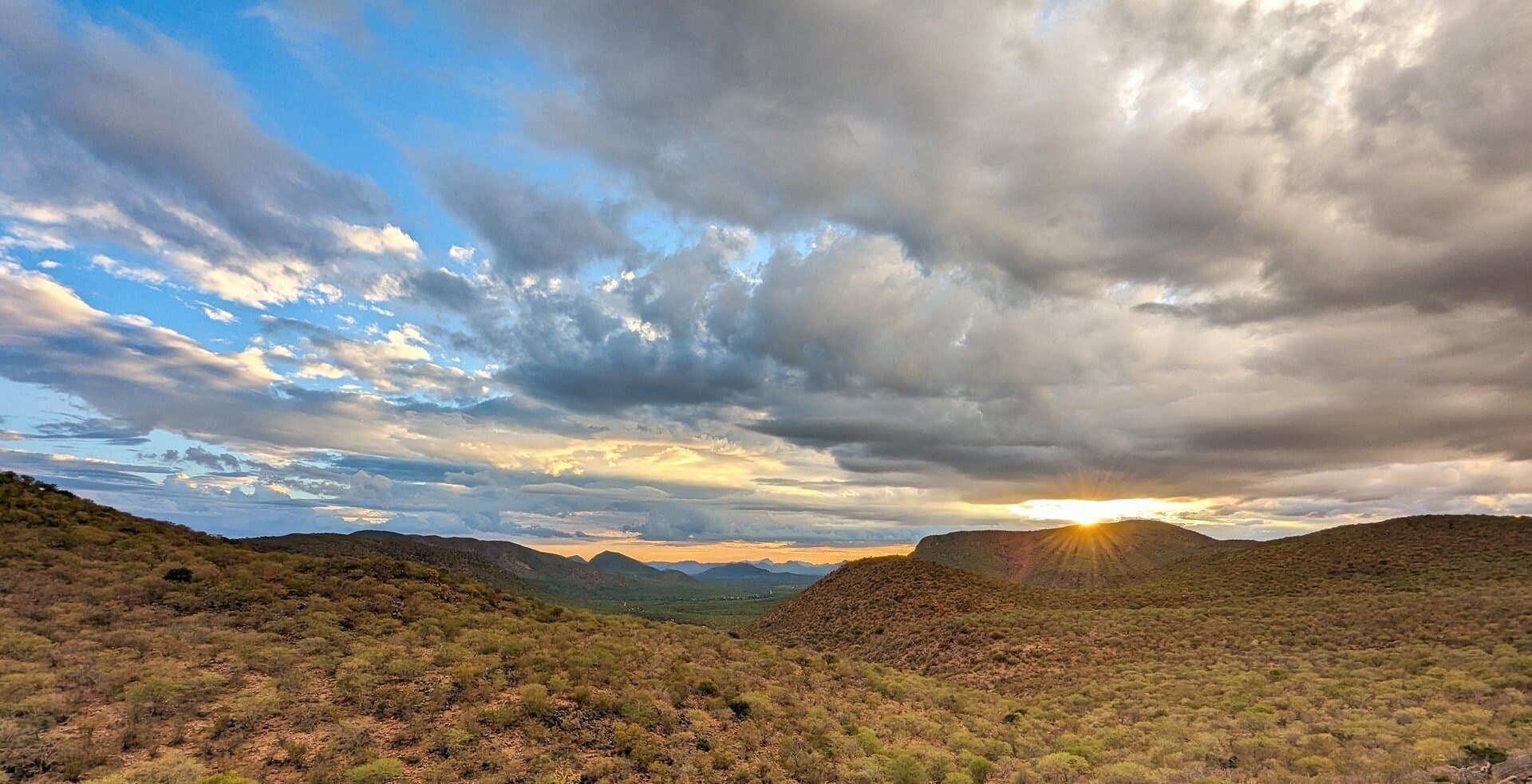
In April the rain eases off (still 38 millimeters on average in Windhoek); in May only about 7 millimeters fall. The days are a pleasant 23 to 26 °C, the nights already crisp at 9 to 13 °C. The land still looks green, the air is clear, and the clouds create spectacular light. For hikers and photographers, it's one of the most beautiful times of the year.
June to August: the clear, cool Namibian winter
Now it practically stops raining. Daytime temperatures are 20 to 23 °C, while at night they drop to 6 to 9 °C in the highlands, with light frost now and then. The animals gather at the waterholes, the grass is short, and visibility is excellent. Pack warm clothes for the early mornings, especially for drives in the open safari vehicle. It's peak season, so you should book early.
September and October: warm, dry, and full of game
Temperatures climb to 26 to 29 °C; the nights stay pleasant at 12 to 15 °C. This is when the most animals gather at the waterholes. On the coast, the seal mating season begins at Cape Cross, and in the bay at Walvis Bay you can watch whales in October, often as early as September. Toward the end of October, there may be the odd thunderstorm.
November and December: heat and the first showers
At 30 to 31 °C during the day it gets hot; the nights are mild at 16 to 17 °C. The first showers bring the land back to life, many animals have their young, and on the coast you'll see young seals and flamingos. Officially, the low season begins now, though from December the school vacations bring more people to popular places to stay again.
Best time to visit by interest
The right time to travel depends less on the calendar than on what you want from your trip. The sections below show which months suit which interest best.
When is the best time for a safari in Namibia?
For wildlife viewing, the dry season from May to October is ideal. There's hardly any rain, the vegetation is low, and the animals depend on the remaining waterholes. In Etosha National Park, the waterholes are then the best places to watch from; September and October bring the highest numbers. In the rainy season the animals spread out across the land, but you'll see many young animals.
On a farm like Okavandu, a safari is an experience in any season. Our game drives start in the morning and in the late afternoon, last about two hours, and take you through bushland past the waterholes. In winter, bring a warm jacket for the open vehicle.
When is the best time for hiking and the desert?
April to June and September are best for hiking, when it isn't too hot during the day. For the Namib and Sossusvlei, May to September counts as the best time; in summer, temperatures there sometimes climb above 40 °C. The famous Fish River Canyon Trail, about 85 kilometers long, is usually open only from May 1 to September 15, for groups of three or more with a permit and a medical certificate. In summer, the heat in the canyon is dangerous.
When is the best time for birdwatching and photography?
Bird lovers and landscape photographers get their money's worth in the rainy season. From November to April, migratory birds are in the country, nature is green, and the clouds create dramatic light. The dry season is better for wildlife photography, though, because the animals turn up at the waterholes more predictably and the low light in the early morning and late afternoon makes for especially beautiful pictures. Anyone who wants both should travel in May or November.
When is the best time for the coast?
Swakopmund and Walvis Bay are worth a visit all year round. The cold Benguela Current brings mild temperatures of mostly 15 to 25 °C, frequent coastal fog, and seawater that only reaches 13 to 18 °C. So it isn't a beach vacation. The special high points are the seal mating season at Cape Cross from September to December, with the pups in late November and early December. Then there are the flamingos in the lagoon at Walvis Bay, especially from November to February, and whale watching in September and October.
When is the best time to visit Namibia with children?
For families, May to September is the most comfortable time. It's dry, the days are warm but not hot, and children cope well with long drives or game drives. Plan on warm clothes for the cool mornings and evenings, because at night it gets properly cold in the highlands. From December to February it's very hot, and these are also the school vacation months, so popular places to stay book up faster.
One important point for trips to the north is malaria prophylaxis. Windhoek, the Namib, and the whole coastal region count as malaria-free, while in the north and northeast of the country there is a risk that varies by region and season. Etosha National Park also counts as a risk area, especially in the rainy season. Get travel medicine advice before your trip, especially if children are coming along.
At Okavandu, children of all ages are welcome. On private game drives there's no age limit; on group drives the minimum age is six.
When is the best time for a hunting trip in Namibia?
In Namibia, the legal hunting season for foreign trophy hunters runs from February 1 to November 30; in the hot months of December and January, hunting pauses. The ideal time is usually the dry season from May to September, because game is easier to find at the waterholes then, you can see farther in the bush, and the days are pleasant. When you travel with your family, you also benefit from the mild climate. At Okavandu you can hunt throughout the legal season.
Best time to visit Namibia by region
Namibia is more than twice the size of Germany, and the climate differs a lot from region to region. This overview helps you plan your route.
| Region | Best time | Good to know |
|---|---|---|
| Windhoek and the central highlands | April to October | Mild climate, cool nights in winter down to near freezing, afternoon thunderstorms in summer. |
| Etosha National Park | May to October | In the dry season, the waterholes are wildlife viewing at its purest. Up to about 35 °C in December. Malaria risk area, especially in the rainy season. |
| Namib and Sossusvlei | May to September | Sometimes over 40 °C in summer; an early start pays off all year. |
| Coast (Swakopmund, Walvis Bay) | year-round | Fog, cool air, and a cold sea; seals and flamingos depending on the season. |
| Fish River Canyon in the south | May to September | Hiking trail usually only open from May 1 to September 15; too hot in summer. |
| Zambezi Region in the northeast | June to August | The driest time; in the summer months there are many rainy days there. |
Peak season, low season, and prices
The dry season is also the peak season. Depending on the provider, it runs from June or July to September or October. During this time, flights, rental cars, and lodges are at their most expensive and book up faster.
| Season | Months | What it means for you |
|---|---|---|
| Peak season | June to October | Best wildlife viewing, highest prices, book early. |
| Transition | April and May | Fresh green, pleasant climate, prices rise step by step. |
| Low season | November to March | Green landscape, more peace and quiet, lower prices, heat and thunderstorms. The school vacations in December and January are an exception. |
When is Namibia cheapest?
The cheapest time to travel is the low season from November to March or April. Many visitors stay home then, the national parks are less crowded, and you can often book places to stay at short notice. In return, you have to expect heat and rain.
How early should I book?
For peak season, we recommend booking 6 to 9 months ahead, especially for small, exclusive lodges with only a few rooms and for family rooms. In the low season, a few weeks are often enough.
Namibia through the year
Seasons, natural events, and activities coincide at different times of the year. Keep that in mind to check whether the trip you have in mind can take in a high point such as the seal pups or the open Fish River Trail.
What to pack for each season
The weather in Namibia is dry and sunny, but cool in winter. Dressing in layers is the tried and tested way.
| Category | Winter (May to August) | Summer (November to March) |
|---|---|---|
| Outerwear | Fleece or down jacket, beanie and gloves for cool mornings | Light, airy clothes, a thin rain jacket for thunderstorms |
| Pants and shoes | Long pants, sturdy shoes, warm socks | Light long pants, sturdy shoes, sandals |
| Sun protection | Sunglasses and sunscreen, the sun is still strong | Hat, high-SPF sunscreen, plenty of water |
| Extras | Warm clothes for the evenings, nights can be frosty | Mosquito protection if you travel to malaria areas |
| Coast | Windproof jacket, even in summer | Windproof jacket, fog is common |
Planning your tour: Okavandu as your first or last stop
Many tours of Namibia start and end in Windhoek. Okavandu lies in the Erongo Region near Wilhelmstal, about 1.5 hours from Windhoek and about 2 hours from Hosea Kutako International Airport. After a long overnight flight, that makes a relaxed first leg, and at the end of your trip a quiet last stop before you head back to the airport.
Because the farm lies on the B2, it fits ideally into both classic routes. From here you head north toward Etosha, or on via Swakopmund and Walvis Bay to Sossusvlei. We'll plan and arrange your whole tour if you like.
And the best thing about the seasons at Okavandu is that there's something to experience all year round. In winter, clear, cool mornings wait for you on the game drive; in summer, green bushland and cozy evenings at our bar. On top of that, there are sundowners, the farm tour, and a heated pool.
Common questions about the best time to visit Namibia
Bottom line: finding the right time to travel
There's no single perfect time to travel, but there is a good rule of thumb. If you're after wildlife, hiking, and reliable weather, travel from May to October. If you prefer green landscapes, quiet, and lower prices, come from November to April. Families and hunters usually do best with the period from May to September.
While you plan your trip, feel free to get in touch with us. We'll advise you on the time to travel, the route, and your stay at Okavandu.